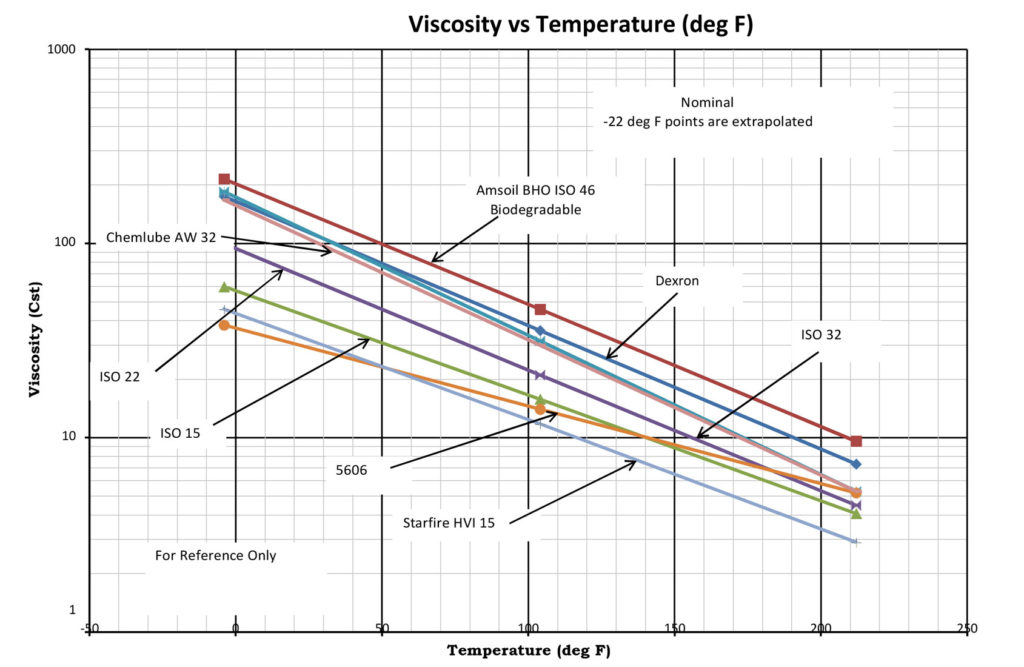
Viscosity Index: How to Read It Without Over-Buying High-VI Oil
Viscosity index (VI) tells you how much a lubricant's viscosity changes with temperature. It does not tell you whether that viscosity will hold up under shear, pressure, or a full drain interval. Buyers who treat VI as a quality score either overpay for improver-heavy oils that shear down mid-service or under-spec a moderate-VI oil that would have protected a hot-running gearbox better.
VI is one input in a three-part decision: base oil type (which sets the VI ceiling), shear stability (which determines whether the VI survives service), and pressure-viscosity coefficient (which determines film thickness under load). Read it as a standalone ranking metric and you will mis-spec the lubricant.
How ASTM D2270 Calculates VI — and Why the 40°C / 100°C Reference Points Matter
ASTM D2270 calculates VI from kinematic viscosity measured at 40°C and 100°C. The method compares the oil's viscosity at those two temperatures against a high-VI paraffinic reference (VI = 100) and a low-VI naphthenic reference (VI = 0), then interpolates. [SEARCH_EVIDENCE]
Kinematic Viscosity at 40°C and 100°C (ASTM D2270)
The 40°C and 100°C points are laboratory reference temperatures — not your component's operating temperatures. A gearbox running at 120°C or a cold start at -20°C sits outside the calculation window. VI describes behavior between two fixed lab points, not at the temperatures your equipment actually sees. [MODEL_ANALYSIS]
How VI Is Calculated — and Why the Reference Oils Matter
Because VI is derived from two points, it does not capture the full viscosity-temperature curve. Two oils with identical VI can have different viscosity at 60°C or 120°C. The reference oils define the scale; they do not constrain the shape of the curve between or beyond the measurement points. Comparing two oils on VI alone compares two numbers that describe a slope — not the absolute viscosity at your operating temperature. [MODEL_ANALYSIS]
High VI vs Low VI: What the Numbers Mean in Practice
High VI is generally >95; low VI is below that threshold, with common ranges spanning roughly 95 to 180+ depending on base oil and VI improver content. [SEARCH_EVIDENCE] That range is wide enough that "high VI" alone is not a useful specification — a 100 VI mineral oil and a 180 VI synthetic blend are both "high VI" but behave very differently in service.
VI Thresholds and What They Imply for Different Applications
A rough classification: VI below 95 indicates a naphthenic or low-paraffinic base stock, typically used where temperature variation is modest. VI 95–120 covers most conventional mineral oils and many synthetic blends. VI above 120 generally requires either a high-VI synthetic base stock (PAO, ester) or a significant VI improver package. VI above 150 almost always signals a synthetic base stock, a heavy improver load, or both. [MODEL_ANALYSIS]
Where the 'Higher Is Better' Assumption Breaks Down
High-VI oils typically contain more viscosity index improver polymer, which introduces trade-offs in shear stability, volatility, and oxidation resistance. [MODEL_ANALYSIS] In gear and bearing applications, a moderate-VI oil with better shear stability can outperform a high-VI, improver-heavy formulation over a full service interval. The improver that raises VI at 100°C is the same polymer that can be mechanically sheared apart in a gear mesh — and when it degrades, the VI drops with it. [MODEL_ANALYSIS]
Base Oil vs VI Improver: Where the VI Number Actually Comes From
Base oil type sets the VI ceiling before any additive is added. PAO and ester stocks naturally reach higher VI than mineral stocks, while mineral stocks cap lower. [MODEL_ANALYSIS] A solvent-refined mineral oil might top out around VI 100; a PAO can reach 130–140 without any VI improver; an ester can go higher still. The base oil determines how much headroom the formulator has before reaching for polymers.
Mineral, Synthetic, and the VI Gap
VI improvers are polymer additives that raise the finished oil's VI above the base oil's natural ceiling. [MODEL_ANALYSIS] Two oils with the same VI can have very different base oil quality and very different shear behavior. A high-VI mineral oil with heavy improver content and a moderate-VI PAO-based oil can post similar VI numbers but behave differently under shear, pressure, and oxidation. The mineral oil relies on polymers to hit its VI; the PAO relies on its base stock. Over a service interval, the PAO's VI is more likely to hold.
Formulation Trade-Offs: High VI vs Other Performance Properties
Raising VI with improvers consumes formulation headroom that could otherwise go to anti-wear, extreme-pressure, or oxidation-inhibitor chemistry. It also tends to increase volatility (lighter base stocks are often used to offset the improver's thickening effect) and can reduce oxidation resistance if the base stock is not upgraded to match. [MODEL_ANALYSIS] A high VI number is not free. It is a trade against other properties, and the trade is only worth making if the application actually needs the temperature-behavior advantage.
How Viscosity Index Improvers Work — and How They Fail
VI improvers are long-chain polymers that coil tightly at low temperature (contributing little to viscosity) and expand at high temperature (contributing more viscosity). [MODEL_ANALYSIS] This behavior flattens the viscosity-temperature curve, raising VI. The polymer does not change the base oil's inherent temperature response — it overlays a temperature-dependent thickening effect on top of it.
Polymer Chemistry Basics: What VI Improvers Do at Low and High Temperature
At cold start, the coiled polymer is compact and the oil flows close to its base oil viscosity. At operating temperature, the expanded polymer increases viscosity, offsetting the base oil's natural thinning. The result is a multigrade: an oil that meets a low-temperature pumping limit and a high-temperature viscosity grade simultaneously. [MODEL_ANALYSIS] The base oil sets the cold-flow behavior; the improver extends the high-temperature viscosity.
Shear Stability: Why VI Can Drop Over Service Life
VI improver polymers are long-chain molecules that can be mechanically sheared apart in high-stress zones — gear meshes, pump clearances, and bearing contacts — permanently reducing the oil's VI. [MODEL_ANALYSIS] A high-VI oil with poor shear stability can drop to a lower effective VI mid-service, losing the temperature-behavior advantage it was selected for. Shear stability data (for example, viscosity loss after a defined shear test) is the counter-metric buyers should request alongside VI when the component operates under high mechanical stress. [MODEL_ANALYSIS]
Why VI Alone Is Not Enough for Gear and Bearing Selection
Pressure-viscosity coefficient describes how much a lubricant's viscosity increases under high contact pressure — it governs film thickness in gear meshes and bearing contacts, and VI does not capture it. [MODEL_ANALYSIS] In a gear mesh, contact pressures routinely exceed 1 GPa; the lubricant's behavior under that pressure, not its bulk temperature response, determines whether a protective film forms.
Pressure-Viscosity Coefficient: The Missing Parameter
Two oils with identical VI can have different pressure-viscosity coefficients, so they form different film thicknesses under the same load — meaning VI cannot be used as a proxy for load-carrying capability. [MODEL_ANALYSIS] A high-VI oil optimized for temperature stability may have a lower pressure-viscosity coefficient than a moderate-VI oil designed for gear service. In gear and bearing applications, VI should be paired with pressure-viscosity coefficient and shear stability data, not used as a standalone selection metric. [MODEL_ANALYSIS]
When to Prioritize Shear Stability Over Peak VI
If the component operates under high mechanical stress — gearboxes, heavily loaded bearings, hydraulic pumps with tight clearances — shear stability should outrank peak VI. A moderate-VI oil that holds its viscosity through the drain interval protects better than a high-VI oil that shears down to a lower effective VI by mid-service. [MODEL_ANALYSIS] The selection question is not "which oil has the highest VI" but "which oil's VI will still be there at end of drain."
A Practical Selection Framework: Matching Lubricant to Operating Temperature Range
Start with the component's actual operating temperature range, not the lab reference points. The sequence below converts the three decision inputs — base oil type, shear stability, pressure-viscosity coefficient — into a repeatable selection process.
Step 1 — Define the Actual Component Operating Temperature Range
Establish the cold-start minimum and the steady-state maximum at the component, not at the sump or the ambient. A gearbox that sees -20°C cold starts and 120°C steady-state operation has a 140°C span; a hydraulic system running 40–80°C has a 40°C span. The span, not the peak, determines how much VI you actually need. [MODEL_ANALYSIS]
Step 2 — Shortlist ISO VG or SAE Grades
Bracket the operating range with ISO VG or SAE grades. For a 140°C span, a multigrade like 75W-90 or 10W-40 is appropriate; for a 40°C span, a monograde or narrow multigrade may suffice. The grade shortlist defines the viscosity window; VI then tells you how well a candidate holds that window across the span. [MODEL_ANALYSIS]
Step 3 — Check VI, Shear Stability, and Pressure-Viscosity Data
For each candidate, pull VI, shear stability data (viscosity loss after shear), and pressure-viscosity coefficient if available. Rank candidates on shear stability first for high-stress components, on VI first for wide-temperature-span components with low mechanical stress, and on pressure-viscosity coefficient first for gear and bearing contacts. [MODEL_ANALYSIS]
Worked Example: Selecting a Lubricant for a Defined Temperature Range
A fleet gearbox sees -15°C cold starts and 110°C steady-state operation under moderate load. Step 1: span is 125°C. Step 2: shortlist 75W-90 and 80W-140. Step 3: for the 75W-90 candidate, check VI (a VI above 120 is useful here), shear stability (gear meshes shear improvers, so request shear-loss data), and pressure-viscosity coefficient (gear contacts demand film thickness under pressure). A moderate-VI 75W-90 with good shear stability and a high pressure-viscosity coefficient will outperform a higher-VI 75W-90 with heavy improver content that shears down mid-service. [MODEL_ANALYSIS]
Frequently Asked Questions: VI, Multigrade Behavior, and Shear Life
What is a good viscosity index?
It depends on the application. A moderate VI with good shear stability can be the better choice for a hot-running gearbox than a higher VI with improver-heavy formulation. [MODEL_ANALYSIS] For wide-temperature-span, low-shear applications, VI above 120 is useful. For high-shear gear and bearing applications, shear stability matters more than the VI number itself.
Does high VI oil always protect better?
No. High VI protects better only if the VI survives the shear environment. [MODEL_ANALYSIS] In high-stress components, a high-VI oil with poor shear stability can lose its advantage mid-service, ending the drain interval with a lower effective VI than a moderate-VI oil that held its viscosity.
How does multigrade oil maintain viscosity across temperatures?
Multigrade oil maintains viscosity across temperatures through base oil selection plus VI improver polymers — the base oil sets the cold-flow behavior and the improver extends the high-temperature viscosity. [MODEL_ANALYSIS] The base oil determines the cold-start grade (the "W" number); the improver determines whether the oil meets the high-temperature grade.
Can VI improvers wear out?
VI improvers can degrade over service life through mechanical shear, so "does high VI oil always protect better" has a conditional answer: only if the VI survives the shear environment. [MODEL_ANALYSIS] Permanent shear loss is not reversible — once the polymer chains are cut, the VI is gone for the remainder of the drain interval.