Lubricant Aeration and Air Release: Diagnose the System Before You Change the Oil
If your hydraulic, gear, or transmission system is foaming or running aerated, the first question is not "what additive fixes this" — it is "does my oil's air release time fit my system's residence time?" If it does not, no antifoam package will save you. Fix the system first, then specify the oil.
Air in lubricant exists in four distinct states, and treating them as one problem guarantees you apply the wrong fix.
- Free air — large visible pockets in the reservoir or sump.
- Dissolved air — invisible and saturation-dependent. At atmospheric pressure, most mineral oils hold 8–10% dissolved air by volume. This air does not affect lubrication.
- Entrained air — microscopic bubbles suspended throughout the oil volume. This is the damaging phase: it collapses the oil film in bearings, pumps, and gears, causing metal-to-metal contact, cavitation, and erratic actuator response.
- Surface foam — stable bubbles at the air-oil interface in the reservoir. Mostly a nuisance, but a reliable indicator of surfactant contamination.
The critical distinction: antifoam additives target surface foam, not entrained air. If your problem is entrained air and you add silicone antifoam, you waste money and can actually worsen air release by stabilizing the very bubbles you are trying to remove. Entrained air requires either a base oil with faster air separation or a system fix — suction integrity, reservoir redesign, or residence time correction. Foam requires addressing contamination or surfactant sources. Diagnose which phase you have before reaching for an additive.
Air Release Value and Test Methods: Reading ASTM D3427, D892, and D6082 Correctly
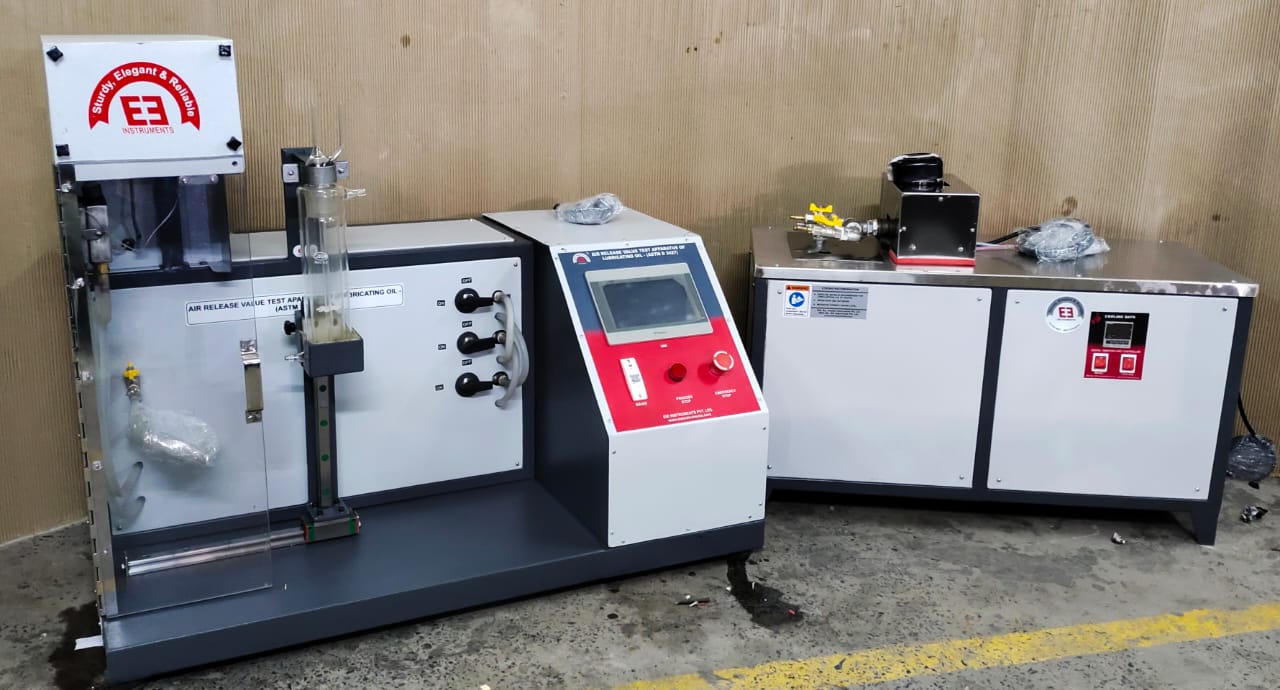
ASTM D3427 is the test that matters for entrained air. It measures the time in minutes for entrained air to drop to 0.2% by volume at a specified temperature. A lower number means faster air release. This is the number you use for system residence time calculations. Typical values range from 2–4 minutes for well-formulated hydraulic oils to 8–12+ minutes for high-VI paraffinic oils with heavy VI improver treat rates.
ASTM D892 measures foaming tendency and foam stability in milliliters across three sequences (I, II, III). This is a foam test, not an entrained-air test. A good D892 result does not guarantee good D3427 performance — an oil can pass D892 with flying colors while having terrible air release. Do not confuse the two when comparing data sheets.
ASTM D6082 is the high-temperature foaming test at 150°C, relevant to gear oils and high-speed bearing sumps where thermal foaming occurs. It uses the same mL units as D892 but at elevated temperature.
Air release time is strongly temperature-dependent. A 46 cSt hydraulic oil might release air in 4 minutes at 50°C but take 12+ minutes at 25°C. Always compare D3427 results at the same test temperature. A data sheet showing "air release: 5 minutes" without a temperature is incomplete — demand the test temperature before making a specification decision.
Calculate Required Air Release Performance from System Residence Time
Residence time is how long oil spends in the reservoir per pass. Calculate it as reservoir volume in liters divided by pump flow rate in liters per minute. A 200 L reservoir with a 100 L/min pump has 2.0 minutes residence time.
The specification rule: required air release time (D3427, at operating temperature) should be no more than 50–70% of residence time. This allows a safety margin for viscosity effects and contamination. For the example above, the oil's D3427 air release time at operating temperature should be ≤1.0–1.4 minutes. A general-purpose ISO VG 46 hydraulic oil typically shows 5–8 minutes — it will not meet this requirement, and the system will run aerated.
If no commercially available oil meets your calculated requirement, the fix is reservoir redesign — adding baffles, increasing volume, or slowing return flow — not a different additive package. Antifoam additives do not improve D3427 air release time; they only address surface foam. This is the step most troubleshooting guides skip: they recommend oil changes or additives when the real problem is that the reservoir is too small for the pump flow rate.
Root Causes: Mechanical, Chemical, and Operational Sources of Aeration
Mechanical causes are the most common and the most fixable. Suction line leaks draw air in under vacuum — check every fitting, flange, and hose clamp between the reservoir and pump inlet. Undersized or submerged return lines prevent proper air separation. Missing baffles allow return flow to whip air into the bulk oil. Pump cavitation and flow surges from rapid valve actuation also entrain air.
Chemical causes include water contamination (emulsified water stabilizes foam), mixed incompatible oils (detergent/dispersant antagonism), and degraded oil producing polar byproducts that stabilize bubbles. If you have topped up with a different brand or type of oil, you may have created a foam problem that no additive can fix.
Operational causes: oil level too low (pump draws air), oil level too high (return flow entrains air), and operating temperature outside the oil's design window. High temperature thins the oil and can increase air entrainment; low temperature increases viscosity and slows air release.
Diagnostic sequence: check oil level → inspect suction integrity → test for water → verify oil identity → then and only then consider additive treatment. This sequence solves 80% of aeration problems without spending money on additives or oil changes.
How Base Oil Composition and VIIs Affect Air Release
Naphthenic base oils generally release entrained air faster than paraffinic base oils of the same viscosity. This is due to differences in surface tension and internal fluid structure — naphthenics have lower surface tension and allow bubbles to coalesce and rise more quickly. If your system has short residence time, a naphthenic hydraulic oil may solve the problem where a high-VI paraffinic oil cannot.
High-viscosity-index (HVI) paraffinic oils and oils with high treat rates of viscosity index improvers (VIIs) tend to have slower air release because the polymer chains stabilize bubbles. The higher the VI, the more VII polymer is typically required, and the worse the air release becomes. This is a trade-off: you get better viscosity-temperature behavior but worse air separation.
Ester and PAO synthetic base stocks vary widely. Some PAOs release air faster than mineral oils; some slower. "Synthetic" is not a shortcut to good air release — you must check the D3427 data for the specific product. Esters often have good air release but can be sensitive to contamination.
Practical implication: if residence time is short, specify a naphthenic or carefully selected synthetic base oil. Do not assume that a higher-quality or more expensive oil will automatically have better air release — check the test data.
Antifoam Additives: Silicone vs. Non-Silicone, Limitations, and Antagonistic Interactions
Silicone antifoams are highly effective at suppressing surface foam but have three significant limitations. First, they can be filtered out by fine filtration (below 5 microns), removing the antifoam and allowing foam to return. Second, they can poison some downstream processes (painting, plating) if the oil migrates. Third, they can actually slow air release by stabilizing entrained bubbles — the silicone coats the bubble surface and prevents coalescence.
Non-silicone (organic polymer) antifoams are more shear-stable and filtration-friendly but generally less potent and more sensitive to contamination. They are a better choice for systems with fine filtration or where silicone contamination is a concern.
Antifoam additives can be antagonized by detergents, dispersants, and other polar additives. Adding antifoam to an oil with high detergent treat rate may do nothing or make things worse. This is why additive-first troubleshooting often fails: the formulation chemistry is more complex than "add antifoam, solve foam."
Adding antifoam to an in-service oil is a temporary patch at best. It does not address entrained air, does not fix mechanical air ingress, and can create compatibility problems with the next oil fill. Use it only as a short-term measure while you diagnose and fix the root cause.
Replace the Oil or Fix the System? Decision Criteria and the Aeration–Varnish Link
Replace the oil when: D3427 air release time has degraded beyond the calculated system requirement, water content exceeds limits (typically >500 ppm for hydraulic oils), or oil identity is unknown/mixed. If the oil is old, contaminated, or the wrong type, replacement is the correct first step.
Fix the system when: oil analysis shows the oil is within spec but aeration persists. This points to suction leaks, reservoir design, or operating conditions. No oil change will fix a mechanical air ingress problem.
Treat the oil (dehydrate, filter, top-treat) only when the root cause is confirmed contamination and the base oil is otherwise sound. Dehydration removes water that stabilizes foam. Filtration removes particulate that can stabilize bubbles. Top-treating with antifoam is a last resort.
Entrained air accelerates oxidation and varnish formation because air bubbles concentrate oxygen at hot metal surfaces. Chronic aeration is a leading indicator of varnish, not just a performance nuisance. If you see varnish forming, check for aeration — the two problems are linked. Solving aeration often solves varnish before it becomes a costly failure.
FAQ
What is a good air release value for hydraulic oil?
It depends on your system's residence time. Calculate residence time (reservoir volume ÷ pump flow) and specify an oil with D3427 air release time at operating temperature no more than 50–70% of that value. For a 2-minute residence time, look for ≤1.0–1.4 minutes.
Does antifoam additive fix entrained air?
No. Antifoam additives target surface foam, not entrained air. They can actually worsen air release by stabilizing bubbles. Fix the root cause — suction leaks, reservoir design, or oil selection.
Why does my hydraulic oil foam?
Foam indicates surfactant contamination — water, mixed oils, or degraded oil. Check for water ingress, verify oil identity, and inspect suction integrity before adding antifoam.
Can I use a higher-quality oil to fix aeration?
Not necessarily. Air release depends on base oil type and VII content, not overall quality. A high-VI synthetic may have worse air release than a naphthenic mineral oil. Check D3427 data.
How often should I test air release?
Test when you suspect aeration, after an oil change, or annually as part of condition monitoring. D3427 is not a routine test for most systems — use it when you have a problem or are specifying a new oil.