Automatic Lubrication Systems: A Reliability-Centered Selection Framework
Select an automatic lubrication system by answering three questions first: how critical is each lubrication point, what duty cycle does it see, and what environment does it operate in. Those three inputs — criticality, duty, and environment — determine whether you need a centralized multi-point system or a single-point automatic lubricator, which lubricant is compatible, and how much monitoring the installation will require. Get any of the three wrong and an "automatic" system becomes a new failure mode.
An automatic lubrication system delivers measured lubricant from a pump and reservoir through lines and metering devices to lubrication points, triggered by a timer or cycle count. It replaces the manual grease gun, not the lubrication engineer. The system controls delivery only. It does not select the correct lubricant, verify that grease reaches the bearing cavity, or adapt when operating conditions change.
Treating automation as a reliability strategy is a category error. Reliability comes from specifying the right lubricant, delivering the right volume at the right interval, and confirming that delivery. Automation improves repeatability and reduces labor, but it introduces its own failure modes: clogged lines, pump failure, incorrect timer settings, and lubricant incompatibility. A progressive system with a blocked line will continue to cycle while downstream bearings starve. A reservoir that runs dry will not alarm unless you install a level switch.
Automatic lubrication is a delivery mechanism, not a closed-loop control system. Your selection process must start with the equipment and its operating context, not with the catalog.
What Counts as an "Automatic Lubrication System"
The term covers two materially different product families. Buyers searching for "automatic lubrication system" may mean either, and the selection framework, ROI math, and monitoring advice differ between them.
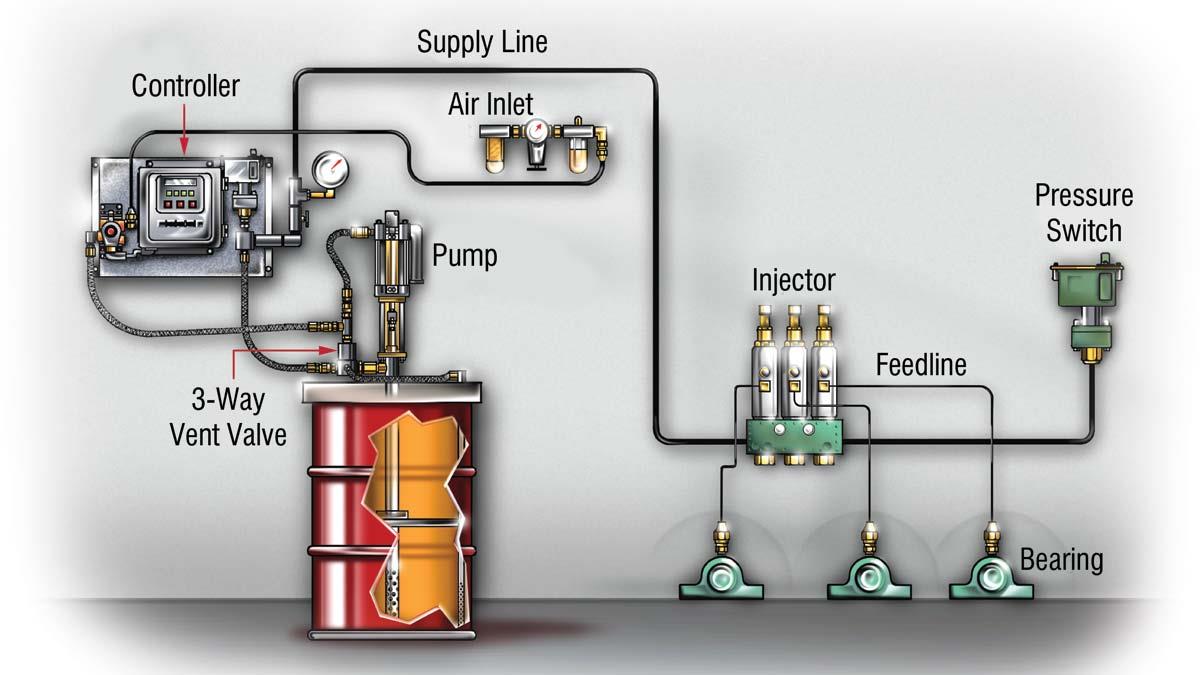
- Centralized multi-point systems use one pump and reservoir feeding multiple lubrication points through distribution lines and metering devices. Sub-types include single-line, dual-line, progressive, and multi-point injector systems. They suit equipment with many points, high lubricant volume, or points that are hard to reach. They require line sizing, metering valve selection, and commissioning pressure checks.
- Single-point automatic lubricators are self-contained gas- or motor-driven canisters that mount on one lubrication point and dispense a fixed volume over a set period. They suit isolated, hard-to-reach, or low-point-count applications. They do not require line design, but they do require correct canister selection for the lubricant and the operating temperature.
Decide which family you are evaluating before you compare features. A single-point lubricator is not a smaller version of a centralized system; it is a different reliability decision.
The Three Inputs That Determine System Type
System type follows from three inputs: criticality, duty cycle, and environment. Classify each lubrication point before you look at a catalog.
Criticality. High-criticality, inaccessible points — bearings inside a continuous caster or a conveyor drive in a confined space — justify progressive or dual-line systems that can confirm metering and handle high pressure. Low-criticality, easily accessible points may not need automation at all.
Duty cycle. Continuous operation with high cycle counts favors progressive or dual-line systems designed for frequent, high-pressure delivery. Intermittent duty may suit a single-line or multi-point system, or a single-point lubricator.
Environment. Dust and moisture require sealed enclosures and corrosion-resistant lines. Washdown areas may require food-grade lubricants and stainless components. Temperature extremes affect pumpability and line pressure.
How System Types Map to These Inputs
- Single-line systems are simple and cost-effective for a limited number of points, but they deliver the same volume to each point and are sensitive to pressure drop.
- Dual-line systems handle large, high-pressure applications with many points and allow zone control.
- Progressive systems meter block-by-block, so a single blocked outlet stops the entire system — a disadvantage for non-critical points but an advantage for critical ones because the blockage is detected.
- Multi-point systems use independent injectors, offering flexibility and isolation, but at higher cost per point.
- Single-point automatic lubricators isolate one point per device, with no line design, but no central monitoring either.
Selection Sequence
- List points and decide whether you are specifying a centralized system or single-point lubricators.
- Classify criticality.
- Assess duty and environment.
- Shortlist system types.
- Verify that the chosen type can deliver the required volume at the required pressure to the farthest point under worst-case temperature.
Lubricant Compatibility: The Design Input Most Buyers Ignore
Lubricant compatibility is a design input, not an afterthought. NLGI grade, base oil viscosity, and thickener type constrain pump, line, and metering valve selection.
- NLGI grade affects pumpability. Higher grades (e.g., NLGI 2) may require larger lines or heated reservoirs in cold environments.
- Base oil viscosity influences flow resistance. High-viscosity oils may not flow through small lines at low temperatures.
- Thickener type — lithium, calcium sulfonate, polyurea, and others — affects compatibility with seals, line materials, and other lubricants. Mixing incompatible thickeners can cause hardening or softening, leading to blockages or leakage.
The system's metering valves and pump must be rated for the lubricant's viscosity and thickener. Using an incompatible lubricant can clog lines or damage the pump.
Compatibility Verification Checklist
Before specifying, obtain the lubricant's technical data sheet and the system manufacturer's compatibility chart, then compare these specific parameters:
- Base oil viscosity at 40°C against the pump's rated viscosity range. If the lubricant's viscosity at the lowest expected ambient temperature falls outside the pump's rated range, the pump will not meter reliably.
- NLGI grade against the line diameter and the lowest expected ambient temperature. Higher grades in small lines at low temperature are a common cause of no-flow.
- Thickener type against seal elastomer compatibility and against any lubricant already in the system. If switching thickeners, flush the system and verify compatibility with the new thickener.
- Additive package against the metering valve's wetted materials, if the valve manufacturer publishes a compatibility list.
If you plan to switch lubricants, flush the system and verify compatibility with the new thickener before returning to service. For automotive and fleet workshops, the same discipline applies to vehicle lubrication points: use the specified lubricant for each application.
A note on scope: lubricant manufacturers publish compatibility data for their own lubricants. They cannot certify compatibility with every pump, valve, and seal on the market. Confirm the final selection with your system OEM; our data covers our lubricants only.
Installation Mistakes That Turn an Automatic System into a New Failure Mode
Most automatic lubrication system failures trace back to installation, not the pump.
- Undersized lines cause excessive pressure drop, starving downstream points. Always size lines per the manufacturer's flow and pressure requirements, accounting for the farthest point and lowest expected temperature.
- Incorrect metering valve placement — too far from the bearing or in a location exposed to washdown — leads to under-lubrication or contamination. Mount valves close to the point and protect them from water and debris.
- Contaminated fill procedures introduce dirt or water into the reservoir, which can clog valves and damage bearings. Use clean transfer equipment and filter the lubricant if specified.
- Blocked grease fittings — paint, rust, or debris — prevent lubricant from reaching the point. Always verify free flow before connecting lines.
Commissioning: Pressure and Flow Verification
Commissioning is where installation errors surface. Work through these steps before handing the system over:
- Verify free flow at every point with the line disconnected, using a hand pump or the system's manual override. Any point that will not accept lubricant is blocked and must be cleared.
- Confirm pump outlet pressure against the system's rated pressure at the pump, with the lubricant at the lowest expected ambient temperature.
- Confirm pressure at the farthest point in the circuit, not just at the pump. Pressure drop across the line and metering devices is where undersized lines show up.
- Confirm metering device function — for a progressive system, watch the indicator pin cycle; for a dual-line system, confirm line pressure reversal; for single-point lubricators, confirm the canister discharges over the set period.
- Record baseline values — pump pressure, cycle time, and reservoir consumption — so later deviations are detectable.
A pressure test at each point during commissioning will reveal blockages before they cause a failure.
Cost-Benefit and ROI: Separating Hard Savings from Reliability Gains
Hard savings are quantifiable: reduced lubricant consumption (measured in grams per point per cycle), labor hours saved (manual greasing time), and bearing replacement cost avoided. Reliability gains — increased uptime, improved MTBF, reduced unplanned downtime — require your own historical data to quantify. Do not accept generic ROI percentages; they are not transferable.
Variables to plug in: number of lubrication points, manual greasing frequency and labor rate, lubricant cost per unit, bearing failure rate and cost, and production downtime cost per hour. The ROI calculation is (annual labor savings + lubricant savings + avoided bearing/downtime costs) / system cost. This only works if you have reliable baseline data. If you lack failure history, start by tracking manual greasing time and lubricant usage for three months. That data will make your business case credible.
Worked Example (Illustrative Assumptions)
The numbers below are assumptions for illustration only. Substitute your own values.
Assumptions:
- 40 lubrication points on one production line.
- Manual greasing: 2 minutes per point, performed weekly (52 weeks/year).
- Maintenance labor rate: $60/hour (fully loaded).
- Annual manual greasing labor: 40 points × 2 min × 52 weeks = 4,160 minutes = 69.3 hours ≈ $4,160/year.
- Automatic system reduces manual greasing time by 75% (assumption): labor savings ≈ $3,120/year.
- Lubricant consumption reduction of 20% (assumption) on an annual lubricant spend of $1,500: savings ≈ $300/year.
- One bearing failure avoided per year (assumption) at $1,200 in parts and labor: savings ≈ $1,200/year.
- Total annual savings ≈ $4,620.
- Installed system cost (assumption): $8,000.
- Simple payback: $8,000 / $4,620 ≈ 1.7 years.
Change any assumption and the payback changes. The point of the exercise is to force your own inputs into the calculation rather than accept a vendor's percentage.
When Manual Lubrication Is Still the Right Choice
Automatic lubrication is not universally superior.
- Low-criticality equipment: if a bearing failure is inexpensive and non-disruptive, automation may not be justified.
- Low-duty cycles: equipment that runs infrequently may not need continuous lubrication.
- Easily accessible points: if a technician can reach and grease a point safely and quickly, manual may be simpler and more reliable.
- Small number of points: for one or two points, a single-point automatic lubricator may be overkill; manual greasing is fine.
The decision hinges on criticality and accessibility. If a point is hard to reach, runs continuously, or its failure stops production, automation is likely justified. If it is easy to reach and its failure is a minor repair, manual lubrication remains a valid choice.
Debunking 'Set and Forget': Monitoring and Diagnostics Are Part of Ownership
Automatic systems require attention. Reservoir level must be checked regularly; an empty reservoir means no lubrication, even if the pump runs. Pump and line pressure should be monitored; a drop in pressure can indicate a clog or leak. Metering valve function should be verified periodically; some systems offer cycle confirmation or proximity sensors. Advanced diagnostics — pressure transducers, flow sensors — can integrate with predictive maintenance systems, but add cost and complexity. Plan for these tasks from day one.
System-Specific Monitoring Checklist
What you check depends on the system type. The order below follows the lubricant path from reservoir to point.
Progressive systems:
- Reservoir level — top up before it reaches the low mark.
- Pump pressure — confirm it reaches the system's rated pressure during a cycle.
- Indicator pin — confirm it cycles on every pump cycle. A pin that does not cycle indicates a blockage or a failed metering block.
- Downstream points — if the pin cycles but a point is dry, the blockage is downstream of the indicator.
Dual-line systems:
- Reservoir level.
- Line pressure reversal — confirm both lines alternate pressure on each cycle. Failure to reverse indicates a valve or line fault.
- Visible leaks at line connections and metering devices.
Single-line systems:
- Reservoir level.
- Pump pressure at the far end of the line, not just at the pump.
- Metering device function — confirm each device discharges on cycle.
Single-point automatic lubricators:
- Canister discharge — confirm the canister empties over the rated period. A canister that empties early or late indicates a temperature or back-pressure problem.
- Mounting — confirm the canister is still seated and the point is receiving lubricant.
A weekly walk-around that follows the order above will prevent most failures. Record what you find so deviations from baseline are visible.
Putting It Together: A Decision Sequence for Your Equipment
- List all lubrication points and classify criticality (failure impact, cost, downtime).
- Assess duty cycle and environment (dust, moisture, temperature, washdown).
- Decide whether you are specifying a centralized system or single-point lubricators.
- Select candidate system types based on criticality, duty, and environment.
- Verify lubricant compatibility (NLGI grade, base oil viscosity at 40°C, thickener) against pump and line specs, and confirm with the system OEM.
- Design installation to avoid common mistakes (line sizing, valve placement, fill procedures) and commission with pressure and flow verification.
- Calculate ROI using your own data, and decide if automation is justified.
- Plan for monitoring and maintenance from day one, using the checklist for your system type.
This sequence keeps the decision grounded in your equipment and your data. For lubricant selection, contact us for guidance on compatible products.
FAQ
What is the most common mistake when selecting an automatic lubrication system?
Starting with the catalog instead of the equipment. System type must follow from criticality, duty cycle, and environment — not from a default assumption that automatic is better than manual.
How do I choose between a centralized system and a single-point automatic lubricator?
Centralized systems suit many points, high lubricant volume, or points that are hard to reach, and they allow central monitoring. Single-point lubricators suit isolated or low-point-count applications and require no line design, but they cannot be monitored centrally. If you have one or two points, a single-point lubricator is usually the lower-risk choice. If you have many points on one machine, a centralized system is usually the lower-cost-per-point choice.
Do automatic lubrication systems eliminate manual greasing?
They reduce manual greasing, but they do not eliminate maintenance. Reservoir level, pump pressure, and metering valve function still require periodic checks, and the checks differ by system type.
How do I justify the investment?
Use your own baseline data: manual greasing time, lubricant usage, bearing failure rate, and downtime cost. Generic ROI percentages are not transferable. If you lack failure history, track manual greasing time and lubricant usage for three months before building the business case.